Mining Productivity Study — AI vs Manual Grinding Operations
A 25-day industrial test at a Canadian gold producer shows Brainiall AI delivering a verified +6% productivity gain in grinding operations with lower energy intensity.
1. Introduction
The application of Brainiall artificial intelligence in the mining industry has become increasingly relevant, enabling significant improvements in operational efficiency, cost reduction, and enhanced performance outcomes. The technology has been applied across various stages of mining operations, including planning, prospecting, processing, and monitoring.
As part of an initiative to explore this intelligent control system, a leading Canadian mid-tier gold producer conducted a controlled industrial test to validate Brainiall's AI application in milling, aiming to increase productivity rates.
2. Objective
The primary objective of this study was to evaluate the performance of Brainiall AI in grinding operations. A comparative analysis was conducted between the existing manual operation and the AI system, focusing on productivity (tons per hour), particle size distribution (p80), and energy consumption.
3. Methodology
Over a two-year collaboration between Brainiall and the gold producer's process engineering team, an intelligent system for grinding control was developed. Following its implementation, comparative tests were conducted between the Brainiall AI-driven system and manual operations.
The official testing period spanned January 10, 2024 to February 5, 2024, with operational modes alternated every 48 hours to account for variances such as rock type, feed blend, % solids, and operational rates. A total of 25 days of data was collected.
- Blue days: Manual operation
- Orange days: Brainiall AI operation
- Red days: Maintenance periods (excluded from the analysis)
- Only periods with ≥85% active operational hours were analyzed, ensuring a comparable dataset for both AI and manual systems

4. Results and Discussion
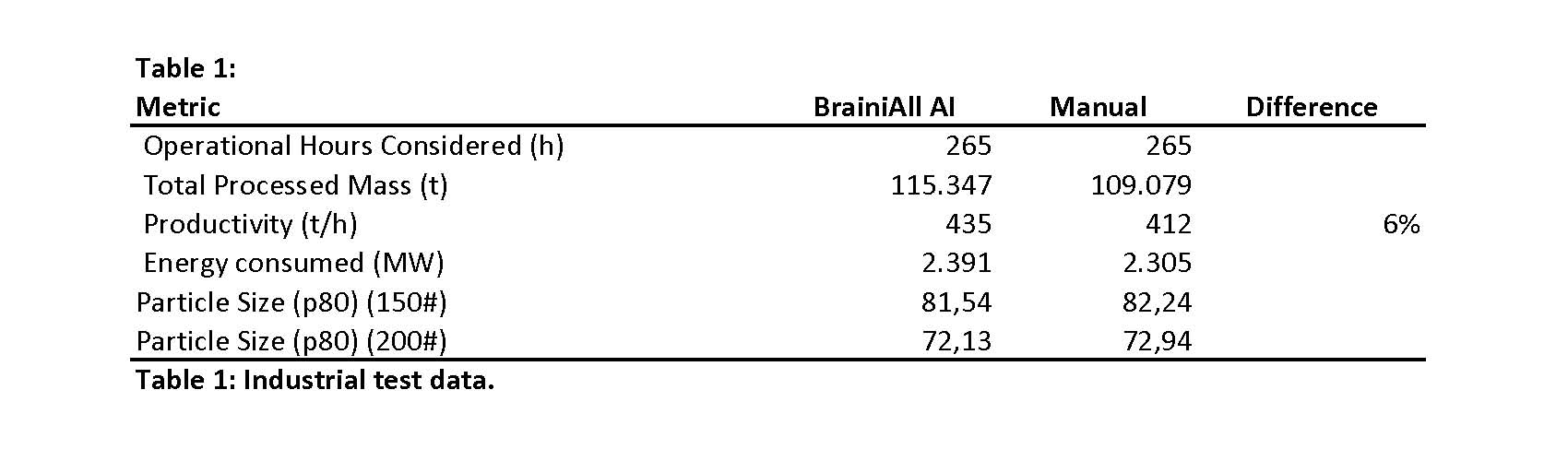
The overall comparison between the AI system and manual operation demonstrates a clear advantage for Brainiall AI in terms of productivity and efficiency. Over 265 operational hours for each method, the Brainiall AI system processed 115,347 tons of material compared to 109,079 tons for manual operation — achieving a 6% higher productivity rate (435 t/h vs 412 t/h).
This improvement was achieved with only a marginal increase in energy consumption. Particle size distribution (p80) values remained consistent between the two methods, indicating that the AI system maintained output quality while enhancing overall performance.
+6% productivity · 435 t/h (AI) vs 412 t/h (manual) · 115,347 tons processed (AI) vs 109,079 tons (manual) · Consistent p80 quality · Marginal energy delta
5. Fresh Rock Analysis
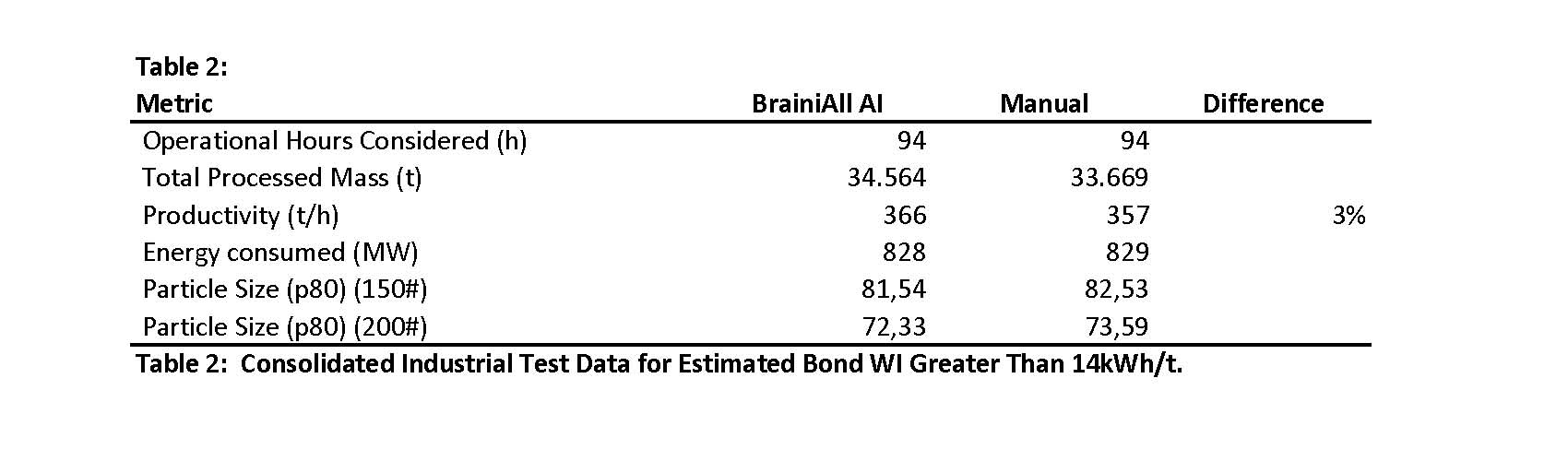
To isolate the impact on harder material, tests were conducted using feed with a Bond Work Index (Wi) ≥ 14 kWh/t. The AI system delivered a 3% productivity increase for harder materials, achieving rates above plant design specifications despite higher ore hardness.
The AI system proved effective across varying ore hardness conditions — a critical capability as ore grades decline and hardness increases across global mining operations.
6. Operational Stability & Particle Size
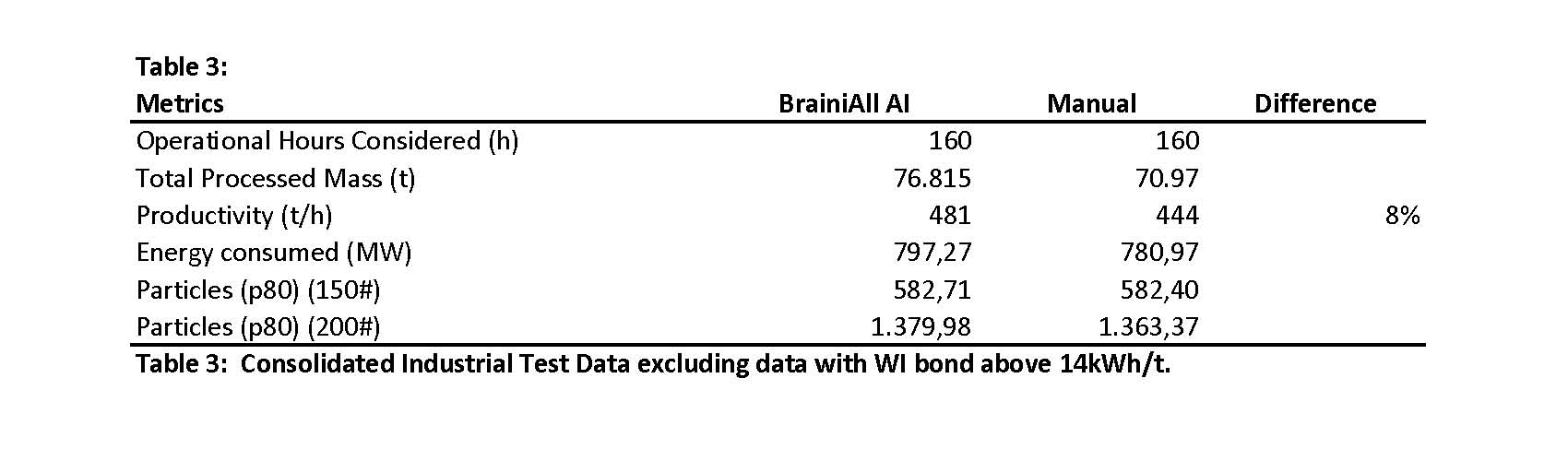
Beyond raw throughput, the AI system reduced operational variance and maintained tighter control over particle size distribution (p80). Lower variance translates directly into less equipment stress, fewer unplanned stoppages and more predictable downstream recovery in flotation.
7. Energy Intensity
Specific energy consumption (kWh/t) remained essentially flat between AI and manual modes despite the +6% throughput gain — meaning the extra tonnage was produced without a proportional increase in power draw. In practical terms, this is a reduction in energy intensity per ton.
8. Financial Impact
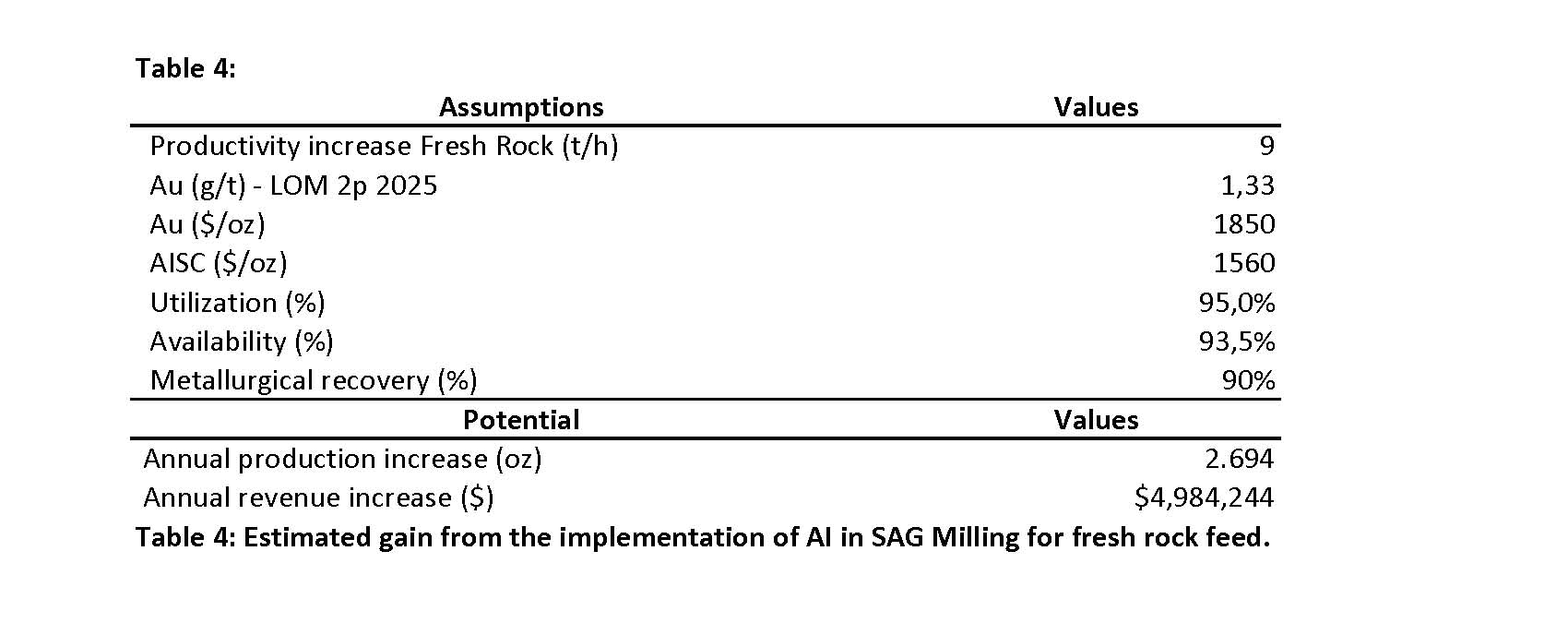
Extrapolated over a full operational year at this plant, the +6% productivity gain translates to an estimated 2,694 additional ounces of gold produced annually, representing approximately $781,000 in incremental annual profit (net of AISC).
Results may vary with ore grade, hardness, and site-specific operational conditions. A detailed version of this study was published in Brasil Mineral Magazine (Issue 441, July 2024).